
Weimaraner colours explained: silver, mouse grey, roe, and why "blue", "black" and "brown" Weimaraners confuse people
Weimaraners come in shades of grey: silver, mouse and roe grey, as the standards describe. Here is what "blue", "black" and "brown" really mean.
Every Weimaraner the breed standards recognise is grey. The standards name the shades silver, mouse and roe grey, and allow only small white marks, so "blue", "black", "brown" and "red" Weimaraners are either a coat the standards reject, a trick of the light, or a different dog altogether. This guide, part of the breed hub, goes through what each word means and what to ask when someone advertises a rare colour. For the rest of the breed's looks, see the owner's guide to the Weimaraner.
Key takeaways
- Grey is the only colour every standard accepts; the shades run from silver to mouse and roe grey.
- "Blue" is a recognisably different coat that the AKC disqualifies and the UK lists as non-standard.
- A rare colour is never a reason to pay more: see choosing a responsible breeder.
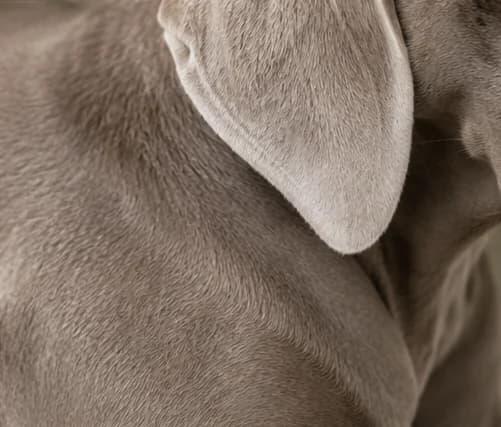
What colours do the breed standards allow?
Grey, in a range of shades, and nothing else. The wording differs a little between registries, but the answer is the same in each.
| Standard | Colour wording | Not allowed |
|---|---|---|
| FCI (most of Europe and many other countries) | "Silver, roe or mouse grey, as well as shades of these colours" | "Colour other than grey. Blue colouring." (disqualifying) |
| Dogs Australia | Same wording as the FCI | Same disqualifications as the FCI |
| Royal Kennel Club (UK) | "The only correct colour is grey. Silver grey preferable." Mouse or roe grey acceptable | "Blue, and any other colour, or combination of colours unacceptable" |
| AKC (US) | "Solid color, in shades of mouse-gray to silver-gray" | "A distinctly blue or black coat is a disqualification" |
Sources for the table: FCI Standard 99, Dogs Australia breed standard, Royal Kennel Club breed standard and AKC standard, each quoted from the registry's own published text.
The Royal Kennel Club's breed information page lists mouse grey, roe grey and silver grey as breed-standard colours and blue as a non-breed-standard colour (Source: Royal Kennel Club breed information). The standards also agree that the head and ears are usually a little paler than the body (Sources: FCI Standard 99, AKC standard).
Silver, mouse and roe grey: what do the words mean?
They are names for shades, not measurements. No standard gives a colour chart, so two judges, or two breeders, can use the same word for slightly different dogs.
- Silver grey is the light end of the range. The Royal Kennel Club says it is preferred (Source: Royal Kennel Club breed standard).
- Mouse grey is the deeper, darker end. The AKC describes its range as running from mouse-gray to silver-gray (Source: AKC standard).
- Roe grey, named after the roe deer, is named in the FCI, Dogs Australia and Royal Kennel Club standards but not in the AKC's (Sources: FCI Standard 99, Royal Kennel Club breed standard).
The Weimaraner Club of America (WCA), in its judges' education guide to the US standard, describes the colour as "a grayish-taupe" that "varies from very light shades to deep rich shades", always with that taupe tone and "never a true brown or blue color" (Source: WCA, Judges' Education Presentation). The Royal Kennel Club adds that the whole coat "gives an appearance of metallic sheen" (Source: Royal Kennel Club breed standard).
A few other things change how a grey coat looks:
- A paler head. The WCA calls the lighter shading on the head and ears the "Grafmar Cap", and says it becomes more prominent with age (Source: WCA, Judges' Education Presentation).
- A darker stripe down the back. The Royal Kennel Club says a dark eel stripe frequently occurs along the back, and the FCI mentions a "more or less defined trace" there (Sources: Royal Kennel Club breed standard, FCI Standard 99).
- Shedding. The WCA says a shedding Weimaraner often shows a spotted or mottled pattern that disappears with the new coat (Source: WCA, Judges' Education Presentation).

Why is a Weimaraner never really brown?
Because the standards rule it out, and because most "brown" Weimaraners are grey dogs seen in the wrong light. The FCI standard lists "deviations from grey tones, such as yellow or brownish, tan brand" among its disqualifying faults (Source: FCI Standard 99). Dogs Australia, which uses the FCI wording, adds that brown marking is a serious fault and that a dog with definite reddish-yellow markings can be graded no higher than "good" (Source: Dogs Australia breed standard). The WCA's judging guidance says the colour should not give the appearance of being brown, liver or black (Source: WCA, Judges' Education Presentation).
So what are people looking at when they search for a brown or "red" Weimaraner?
- Sun and light. The WCA notes that Weimaraners are "avid sun bathers" and that their coat is easily sun-bleached, "giving it a more brownish cast" (Source: WCA, Judges' Education Presentation). Warm evening light and phone cameras exaggerate the taupe in the coat, too.
- Tan markings. In the WCA's 2012 owner survey of 482 dogs, about 1.5 in every 100 dogs were reported to have "Dobe marks", tan markings like a Dobermann's (Source: WCA 2012 health survey). Under the FCI and Dogs Australia standards, tan or brownish markings are faults (Sources: FCI Standard 99, Dogs Australia breed standard).
- A different breed. Silver and charcoal Labradors, and Weimaraner crosses, are often mistaken for Weimaraners in photos. A silver Labrador is a Labrador, whatever its colour, and a cross is a cross; our comparison of the silver Labrador and the Weimaraner shows how to tell them apart. If a breeder calls a dog a Weimaraner, both parents' registration papers should say so.
Black and "blue" Weimaraners: what is that coat, and what does each registry say?
A "blue" Weimaraner has a coat with a cooler, charcoal or slate tone instead of the breed's grey-taupe. A truly black Weimaraner is not something any standard describes. Both are outside every standard:
- The AKC disqualifies "a distinctly blue or black coat" (Source: AKC standard).
- The FCI disqualifies "Colour other than grey. Blue colouring." (Source: FCI Standard 99), and Dogs Australia uses the same wording (Source: Dogs Australia breed standard).
- The Royal Kennel Club says blue is unacceptable and lists it as a non-breed-standard colour (Sources: Royal Kennel Club breed standard, Royal Kennel Club breed information).
The WCA's position is plain: "The blue weimaraner is not recognized in any country worldwide. The blue weimaraner is not a rare breed. They are deliberately produced." It adds that the purebred heritage of blue dogs "is a matter of dispute", and that a blue Weimaraner can still be registered with the AKC and compete in AKC activities other than the show ring (Source: WCA, How To Choose A Weimaraner Breeder). In the WCA's 2012 owner survey, blue coats were reported in about 3.5 in every 100 dogs (Source: WCA 2012 health survey).
What the genetics say, as far as we can cite them
The WCA describes the Weimaraner's coat colour as "a dilute" (Source: WCA, Judges' Education Presentation). Dilution is a recessive trait: a dog needs two copies of the dilute gene variant to show it. In research on other breeds, dilution turns black pigment into "silvery grey (blue)" (Source: Philipp et al. 2005). That study also listed a Weimaraner among its dilute dogs (Source: Philipp et al. 2005).
That is as far as the sources we could open go. The commonly repeated explanation of exactly which base colour sits under the grey coat, and which sits under the blue, is not something we have yet checked against a laboratory or a paper that names the breed, so we do not repeat it here. Our guide to blue Weimaraners goes further into what is and is not known.
Markings and white patches: what is allowed?
Very little white. The FCI and Dogs Australia allow only small white markings on the chest and toes, and treat white anywhere else as a serious fault (Sources: FCI Standard 99, Dogs Australia breed standard). The Royal Kennel Club allows a small white mark on the chest (Source: Royal Kennel Club breed standard). The AKC permits a small white marking on the chest, penalises white anywhere else, and counts white other than a chest spot as a very serious fault (Source: AKC standard).
Two details are easy to miss:
- Injury marks do not count. The AKC and the Royal Kennel Club both say white spots caused by injury should not be penalised (Sources: AKC standard, Royal Kennel Club breed standard).
- Small white marks are not rare. In the WCA's 2012 owner survey, about 10 in every 100 dogs had white on the back of the pasterns, and about 2.5 in every 100 had a large white chest patch (Source: WCA 2012 health survey).
A white mark matters in the show ring. It says nothing about whether a dog will be a good companion.
Are there "mini", wire-haired or long-haired Weimaraners?
- Long-haired: yes. It is a recognised coat variety in the FCI standard and in the UK, though not in the US show ring. See our guide to the long-haired Weimaraner.
- Wire-haired: no. The FCI standard describes two coat varieties, short-haired and long-haired (Source: FCI Standard 99). A wiry-coated "Weimaraner" is most likely a cross.
- Mini: no. Every standard sets a height range, and the FCI disqualifies a dog more than 2 cm outside it (Source: FCI Standard 99). The AKC disqualifies a deviation of more than one inch either way (Source: AKC standard). A dog sold as a "miniature Weimaraner" is not described by any standard.
Does colour affect health or temperament?
For temperament, we found no evidence we can cite that a Weimaraner's shade of grey, or a blue coat, changes how it behaves. Temperament comes from the dog's parents, how it was raised and how it is trained; our temperament guide covers what to expect.
For health, the picture is less clear. In research on dilute dogs, colour dilution is "sometimes accompanied by hair loss and recurrent skin inflammation", known as colour dilution alopecia (Source: Philipp et al. 2005). That finding comes from other breeds, and it does not tell you that a grey or blue Weimaraner will have skin trouble. The FCI standard lists partial or total hair loss as a disqualifying fault (Source: FCI Standard 99). If you are worried about your own dog's coat or skin, your vet is the right person to ask. The health hub lists what we cover so far.
What should you ask a breeder who advertises a rare colour?
Start by treating "rare colour" as a reason for more questions, not as a selling point. The WCA says blue dogs are "deliberately produced" and "not a rare breed" (Source: WCA, How To Choose A Weimaraner Breeder). Breeding for an unusual colour is not the same as breeding for health and temperament, and a "rare colour" premium is one of the patterns in our guide to puppy scams and red flags.
- Ask why they breed for this colour. A breeder focused on health and temperament can explain their choices in those terms.
- Ask for both parents' registration details. Check the names or numbers with the registry yourself.
- Ask for the parents' health test results. Our guide to health tests explained says what to request and how to check it.
- Ask whether every puppy in the litter costs the same. A higher price for a colour the standards reject is a warning sign about the breeder, not a mark of quality.
- Ask to meet the mother. The WCA's breeder questions say it is important to at least see the mother dog (Source: WCA, How To Choose A Weimaraner Breeder).
The responsible breeder guide covers the rest. If you are still deciding whether the breed suits you at all, the breed-fit quiz is a place to start.
Common questions
What is the rarest Weimaraner colour?
There is no rare Weimaraner colour in the standards: grey is the only one accepted. "Rare" usually means a coat the standards reject, such as blue, and the WCA says blue dogs are deliberately produced.
Are silver Weimaraners different from grey ones?
No. Silver is the light end of the same grey range. The Royal Kennel Club prefers silver grey but accepts mouse and roe grey too.
Is a brown Weimaraner purebred?
A Weimaraner that looks brown in a photo is often a grey dog in warm light or a sun-bleached coat. A dog that is truly brown or tan is outside the standards, so ask for both parents' registration papers.
Is there a black Weimaraner?
No standard describes one, and the AKC disqualifies a distinctly black coat. A black "Weimaraner" may be a cross or a different breed, so check the parents' papers.
Do Weimaraner puppies change colour?
The coat stays grey, but the eyes change: the FCI standard describes adult eyes as amber and puppies' eyes as sky-blue. The coat's shade can look different between the puppy coat, a shedding coat and a full adult coat. See the owner's guide for more on how the breed looks.
Sources
- FCI Standard No. 99: Weimaraner (2015)
- AKC: Official Standard for the Weimaraner
- Royal Kennel Club: Weimaraner breed standard
- Royal Kennel Club: Weimaraner breed information
- Dogs Australia: Weimaraner breed standard
- Weimaraner Club of America: Judges' Education Presentation (revised 2021)
- Weimaraner Club of America: How To Choose A Weimaraner Breeder
- Weimaraner Club of America: WCA 2012 On-Line Health Survey, initial results (Health Matters, Nov 2012)
- Philipp et al. (2005): Polymorphisms within the canine MLPH gene are associated with dilute coat color in dogs. BMC Genetics 6:34
Something wrong or out of date? Request a correction.