
How big do Weimaraners get? Height and weight as the breed standards define them
Weimaraners are a large breed. The FCI, AKC and UK standards each set a height range, and the FCI a weight: side by side, with what they do not tell you.
Weimaraners are a large breed, and the people who write the breed standards agree on that much. They do not quite agree on the numbers. The FCI, AKC, Royal Kennel Club and Dogs Australia standards each set a height range, and some give a weight range too. This guide puts them side by side, explains what each one is for and what it is not, and sits in the breed hub beside the Weimaraner owner's guide.
Key takeaways
- The standards describe the ideal show and working dog, not the weight your own dog should be.
- Males are taller and heavier than females under every standard, and the ranges overlap.
- Whether your dog is a healthy weight is a hands-on check with your vet, not a number from a table.
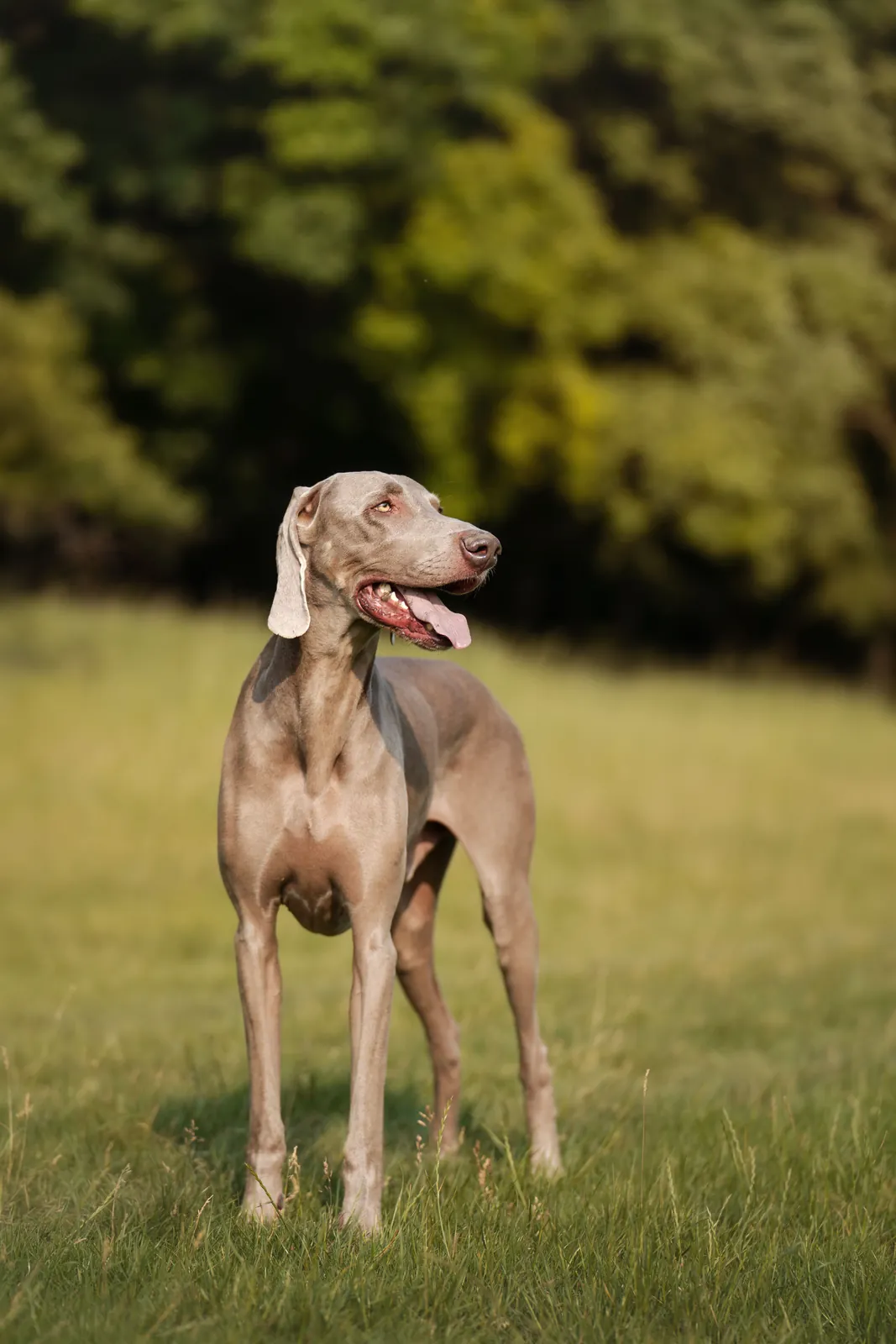
What do the breed standards say, side by side?
A breed standard is a written description of the ideal dog of a breed, used by judges and breeders. Each kennel club writes or adopts its own, which is why the figures differ a little. Heights are measured at the withers, the top of the shoulder blades.
| Standard | Males: height | Females: height | Weight | Source |
|---|---|---|---|---|
| FCI (Europe and many other countries) | 59 to 70 cm | 57 to 65 cm | Males about 30 to 40 kg, females about 25 to 35 kg | (Source: FCI Standard 99) |
| AKC (United States) | 25 to 27 inches | 23 to 25 inches | Not given in the standard | (Source: AKC standard) |
| Royal Kennel Club (UK) | 61 to 69 cm (24 to 27 inches) | 56 to 64 cm (22 to 25 inches) | Not given in the standard | (Source: RKC breed standard) |
| Dogs Australia | 59 to 70 cm, ideal 62 to 67 cm | 57 to 65 cm, ideal 59 to 63 cm | Males about 30 to 40 kg, females about 25 to 35 kg | (Source: Dogs Australia standard) |
A few things stand out. The FCI standard calls the Weimaraner a "medium to large size hunting dog" and gives males a height of 59 to 70 cm and a weight of about 30 to 40 kg (Source: FCI Standard 99). Dogs Australia uses the same ranges and adds a narrower "ideal" band inside each one, 62 to 67 cm for males (Source: Dogs Australia standard). The UK standard gives heights only, in both centimetres and inches (Source: RKC breed standard).
The AKC standard is the strictest about height. Dogs should stand 25 to 27 inches and bitches 23 to 25 inches; one inch either side is allowed but penalised, and a deviation of more than one inch from the standard either way is a disqualification in the show ring (Source: AKC standard). The AKC standard gives no weight, but the AKC's own breed page lists 70 to 90 pounds for males and 55 to 75 pounds for females (Source: AKC breed page).
The UK's Royal Kennel Club puts the breed in its "Large" size category on its breed information page (Source: RKC breed information). The PDSA, a UK veterinary charity, summarises an average height of 56 to 69 cm and an average weight of 25 to 40 kg (Source: PDSA), which is a helpful plain-English summary but not a standard.
What the standards do not tell you
A standard is a picture of the ideal dog for judging and breeding. It is not a target for your dog, and it is not a health measure. None of the four standards says what weight is healthy for an individual Weim, and none of them is a growth chart. Two dogs of the same height can be very different shapes: one leggy and fine-boned, one deeper in the chest and more heavily muscled. The FCI standard itself describes a dog that is "sinewy and very muscular", built for work rather than bulk (Source: FCI Standard 99).
So treat the table as an answer to "roughly how big is this breed?", not "how big should my dog be?".
How different are males and females?
Noticeably. The FCI standard asks for a clear "difference in type between dogs and bitches", and notes that the skull is broader in males (Source: FCI Standard 99). It also describes the muzzle as "especially in the male, powerful" (Source: FCI Standard 99). In numbers, every standard sets a higher range for males: under the AKC standard, a male's range starts at 25 inches, where a female's starts at 23 inches (Source: AKC standard).
The ranges overlap, though. A tall female and a small male can stand at much the same height, and plenty of females are as strong on the lead as any male. If size matters to you, for a car, a home or a person who will walk the dog, look at the parents. A responsible breeder will happily tell you, or show you, how big they are. Our guide to choosing a responsible breeder has the questions to ask.
When do Weimaraners stop growing?
The standards do not say, and there is no reliable growth chart for the breed. What owners notice is that a Weimaraner reaches its adult height well before it looks and behaves like an adult. Many young Weims go through a long, leggy, gangly stage, then fill out through the chest and shoulders later.
Behaviour lags behind too. The Weimaraner Club of America's description of the breed as "the perpetual two year old" is a joke with some truth in it (Source: WCA, Living With A Weimaraner), and the temperament guide covers what to expect through adolescence. A big body with a puppy's judgement is the stage to plan for: strong pulling, counter-surfing and accidental knock-downs all happen at full height.
Growth itself, and how fast a large-breed puppy should grow, is a question for your vet. Our guide to puppy growth and body condition is being written with a vet; until it is published, ask your vet to check your puppy at each visit.
Is my Weimaraner the right weight?
This is the question owners most often bring to a size page, and a table cannot answer it. The right weight for your dog depends on its height, build, muscle and age, so the useful check is body condition: how your dog looks and feels, not what the scales say. Your vet checks this at routine visits and can show you how to do it at home.
Our guide to checking body condition explains the method once a vet has reviewed it, and a printable list of questions to ask your vet about weight and diet is planned. Until then, ask your vet at your next visit. If your dog's weight changes without an obvious reason, ask sooner.
What does a Weimaraner's size mean in everyday life?
A large, athletic dog changes how a home works. None of this is a reason not to have a Weim, but all of it is worth planning for before a puppy comes home.

- Cars. A grown Weim needs room to sit, stand and lie down while travelling, ideally in a secure crate or with a crash-tested harness. Check that the crate you want fits the car before you buy either. A guide to car restraints and travel crates is planned.
- Beds and sofas. Weims like to stretch out, and most of them like to do it next to you. A bed that lets an adult lie flat on its side is worth the floor space. If your Weim will be allowed on the sofa or the bed, decide that early and stick to it.
- Crates. If you use a crate, it needs to let an adult stand, turn and lie flat. Our crate guide covers making it a place your dog chooses to go, and a guide to sizing crates and pens is planned.
- Fences and gardens. Weims are athletic hunting dogs, and many will test a fence that looks easy. The PDSA says a large garden is "an absolute must" for the breed (Source: PDSA). Whatever its size, a garden needs a secure fence; ask the breeder or rescue what height they recommend for their dogs.
- Kitchen counters. At full height, many Weims can reach the worktop. Keep food out of reach and teach a settled alternative, such as lying on a mat, rather than waiting for the habit to start.
- People. A large, bouncy dog can knock over a child or an unsteady adult without meaning to. The Weimaraners and children guide has the details.
- Getting older. Lifting a large dog into a car or up stairs gets harder as dogs and owners age. Our guide to home adaptations for an older Weimaraner covers ramps, floors and beds, and short nails help with grip on any floor: see the grooming guide.
If you are still deciding whether the breed suits your home, the is a Weimaraner right for me? guide covers time, exercise and space honestly.
Common questions
How tall is a Weimaraner?
It depends on the standard. The FCI gives 59 to 70 cm for males and 57 to 65 cm for females (Source: FCI Standard 99); the AKC gives 25 to 27 inches for males and 23 to 25 inches for females (Source: AKC standard).
How heavy is a full-grown Weimaraner?
The FCI standard gives about 30 to 40 kg for males and 25 to 35 kg for females (Source: FCI Standard 99). Your own dog's healthy weight is something your vet judges by body condition, not by a range.
Is a Weimaraner a large or medium breed?
Large, for most practical purposes. The Royal Kennel Club lists it as large (Source: RKC breed information); the AKC standard says "medium-sized" (Source: AKC standard), and the FCI says "medium to large" (Source: FCI Standard 99).
Is my Weimaraner too thin or too heavy?
Ask your vet, who can check body condition by sight and touch. Weims are lean, athletic dogs, and the right shape for one dog is not a number from a table.
Sources
- FCI Standard No. 99: Weimaraner (26 May 2015)
- AKC: Official Standard for the Weimaraner (approved 14 December 1971)
- Royal Kennel Club: Weimaraner breed standard (last updated 1 August 2025)
- Dogs Australia: Weimaraner breed standard
- AKC: Weimaraner breed page
- Royal Kennel Club: Weimaraner breed information
- Weimaraner Club of America: Living With A Weimaraner
- PDSA: Weimaraner
Something wrong or out of date? Request a correction.