
Weimaraners and children: supervision and suitability
Weimaraners can be loving family dogs, but they are big and bouncy, so homes with young children need active supervision, separate spaces and rules.
Weimaraners can be gentle, devoted family dogs, and many children grow up with one as a best friend. They are also large, fast and enthusiastic, so homes with babies, toddlers and young children need a plan: active supervision, separate spaces for dog and child, and rules taught to both. This guide is honest about where the risks lie and what works, so your family and your Weim both stay safe. It is part of the breed hub.
Key takeaways
- Size and bounce matter more than temperament with toddlers: plan for knocks, not just bites.
- Supervision means an adult actively watching, or dog and child apart behind a gate or door.
- Teach the dog to settle away from the action: see settling and calm behaviour.
What is the honest starting point?
Any dog can bite, including a much-loved family dog. The RSPCA in the UK says young children are far more likely to be bitten than any other group, and that people are far more likely to be bitten by their own family's dog than by an unfamiliar one (Source: RSPCA). That is not a reason to avoid dogs. It is the reason supervision and teaching matter in every home, whatever the breed.
Weimaraners bring particular strengths and particular challenges. The breed standards ask for a dog that is friendly and fearless (Source: AKC standard), and Weims are usually deeply attached to their whole family. They also have a lot of energy and a strong need to be involved, and the Weimaraner Club of America describes the breed as "the perpetual two year old" (Source: WCA, Living With A Weimaraner). Our temperament guide explains where that energy comes from. A two-year-old dog and a two-year-old child in the same kitchen need an adult paying attention.
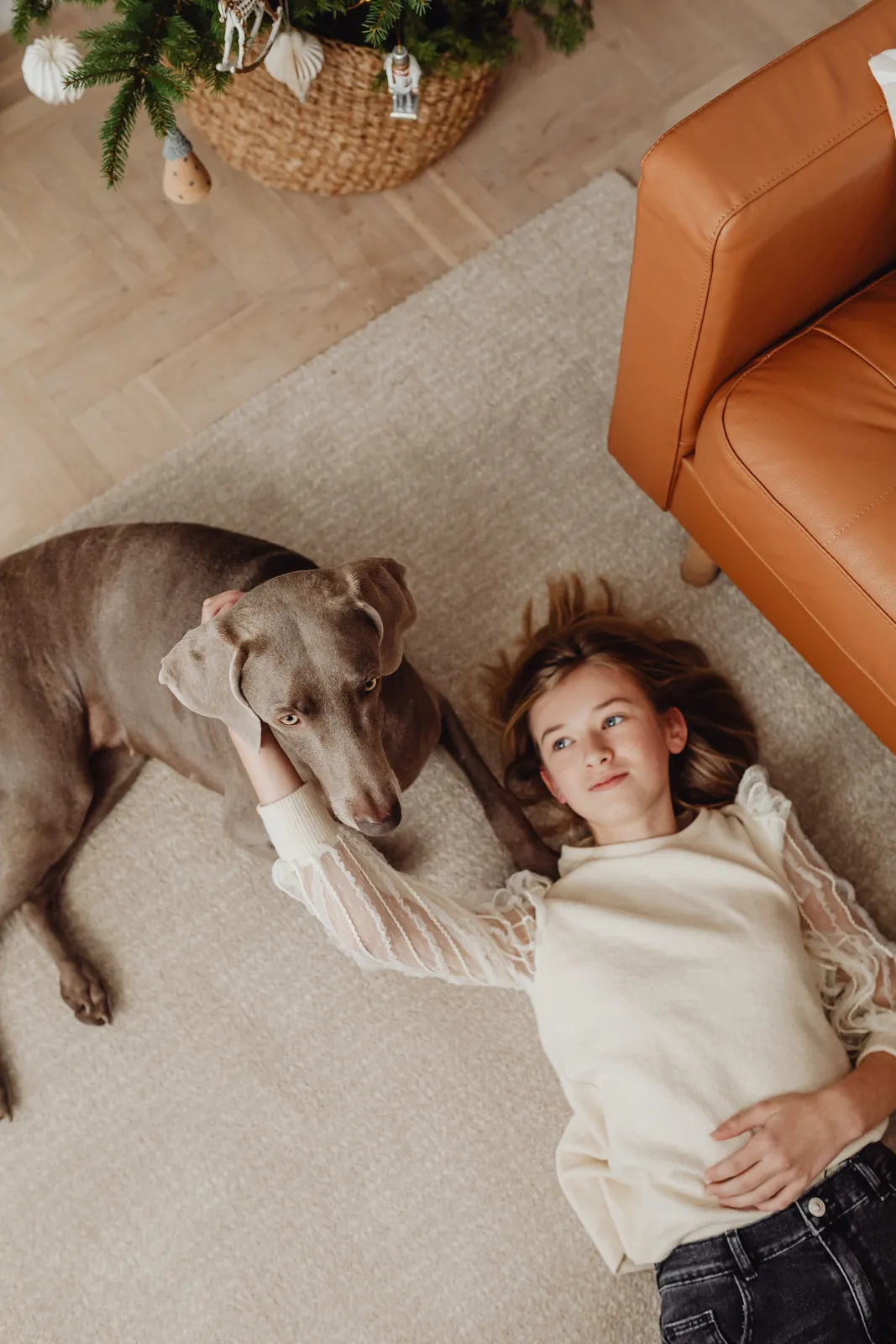
Is a Weimaraner too big and bouncy for toddlers?
It can be. The PDSA says Weims enjoy playtime and are fairly good with children, but because of their size it would not recommend the breed for homes with smaller children, who could be knocked over by accident (Source: PDSA). A Weim greeting the family at the door, zooming around the garden or spinning to catch a toy does not have to be unfriendly to send a toddler flying.
If you already have a Weim and a toddler, or a baby on the way, that is workable with management and training. If you are choosing a breed now and your children are very young, consider waiting a few years, or consider an adult Weim from a rescue that has been assessed with children. See adopting a Weimaraner.
What kind of supervision actually works?
Supervision means an adult is in the room, watching, and ready to step in. Being in the house is not the same. The RSPCA's first rule is to stay with your children around dogs and never leave a child alone in the same room as a dog, even your own (Source: RSPCA).
When you cannot watch, separate. That is not a punishment for anyone; it is the plan.
- Set up separate spaces. Use baby gates, a playpen or a closed door so the dog has a calm zone children cannot enter.
- Give the dog a comfortable retreat. The RSPCA suggests a cosy spot in a quiet room and teaching children to leave the dog alone there (Source: RSPCA).
- Separate at the risky moments. Mealtimes, a child's tired hour, visitors arriving and busy play are when things go wrong.
- Swap, do not chase. If the dog takes a toy or a dropped sandwich, an adult trades it for a treat. Children should never try to take things back.
How do I teach children the rules?
Children and dogs communicate very differently. The RSPCA explains that children tend to hug, kiss, pick up and shout at dogs, which can feel threatening to a dog, and that toddlers can easily step on paws or pull ears and tails by accident (Source: RSPCA). Its golden rules for children include:
- be gentle, and never climb on dogs or pull their ears
- do not approach a dog that is eating, playing with a toy or sleeping
- give a dog space when it moves away or looks unhappy
- do not approach dogs you do not know
- play calm games and teach tricks with an adult
(Source: RSPCA, paraphrased)
The Blue Dog programme, developed by the Blue Dog Trust, is designed to help parents understand how a dog may feel about being hugged, petted or approached in everyday situations, and to reduce the risk of a child being bitten by the family dog (Source: The Blue Dog). It includes a parent guide to read before your child plays.
Older children can take part in training. Teaching a Weim to sit for a treat, or hiding a toy for a scent game, builds a good relationship. Always with an adult present.
How do I teach my Weimaraner to live with children?
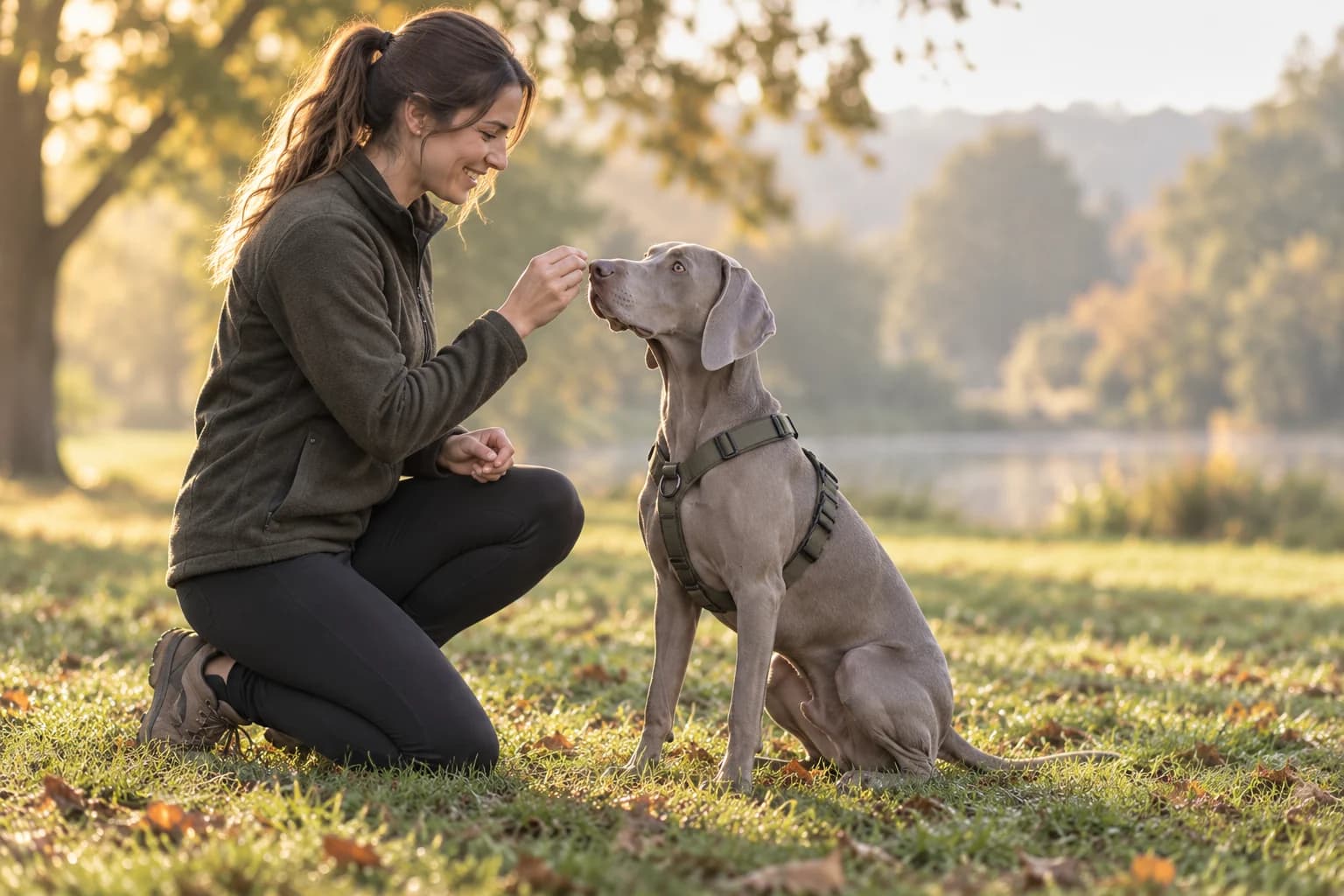
Use rewards, keep sessions short and set the dog up to succeed. The American Veterinary Society of Animal Behavior says reward-based training should be used both for everyday skills and for unwanted behaviour, and that aversive methods should not be used (Source: AVSAB). A dog that has been punished around children may learn to associate children with bad things, which is the opposite of what you want.
Useful skills for a family Weim:
- Settle on a mat or bed in the same room as the family, rewarded with a chew. The RSPCA suggests teaching this "day-bed" before a baby arrives (Source: RSPCA).
- Four paws on the floor for greetings, rewarded generously.
- Drop and trade, so you can swap anything the dog picks up.
- A happy crate or gated area, so time apart is relaxed, not stressful. See crate comfort.
If a baby is coming, the RSPCA suggests getting the dog used to the cot, pram and baby sounds beforehand (Source: RSPCA). Make changes to the dog's routine gradually and early, not on the day you bring the baby home.
When should I get help?
Get help early if you see any of these: your dog stiffens, growls, lifts a lip or snaps around children; your dog guards food, toys or resting places; your dog seems anxious, avoids the children or cannot settle; or you are simply worried. Start with your vet, because pain and illness can change behaviour, then a qualified behaviour professional who uses reward-based methods. AVSAB publishes guidance on choosing a humane trainer (Source: AVSAB, how to choose a trainer).
Growling is a warning, and a useful one. Do not punish it. AVSAB notes that punishment may suppress a behaviour such as aggression without addressing its cause (Source: AVSAB, position statement on rank-based theories), and a dog that has learned not to warn gives you less notice. Separate dog and child, and get help.
Common questions
Are Weimaraners good with kids?
Many are loving with their own family's children. Their size and energy mean young children need close supervision, and the PDSA does not recommend the breed for homes with smaller children.
Should I get a puppy or an adult Weim with young children?
A puppy means mouthing, jumping and chewing alongside small children. An adult rescue dog that has been assessed with children can be an easier fit. See adopting a Weimaraner.
Can my child walk our Weimaraner?
A strong, fast dog with a high prey drive can pull an adult over. Children should only walk a Weim with an adult also holding a lead. See loose-lead walking.
Sources
- RSPCA (UK): Dogs and children
- The Blue Dog programme (Blue Dog Trust, hosted by the University of Lincoln)
- PDSA: Weimaraner
- AVSAB: Position statement on humane dog training (2021)
- AVSAB: How to choose a trainer
- AVSAB: Position statement on the use of dominance theory in behavior modification of animals
- Weimaraner Club of America: Living With A Weimaraner
- AKC: Official Standard for the Weimaraner
Something wrong or out of date? Request a correction.