
Alone-time foundations for a Weimaraner puppy
Teach your Weim puppy that being alone is safe from the first days at home: short, calm absences while they are settled, built up only as they stay relaxed.
The easiest time to teach a Weimaraner that being alone is safe is before they ever learn otherwise. Start in the first days at home with absences so short and calm that your puppy barely notices, and grow them only as fast as your puppy stays relaxed. It is the prevention side of our separation anxiety guide, part of the training and behaviour hub.
Key takeaways
- Practise tiny absences while your puppy is already sleepy, fed and settled, not when they are wide awake
- Come back before your puppy worries, and keep both leaving and returning quiet and ordinary
- If the camera shows panic rather than a brief grumble, make the next absence shorter and see the separation anxiety guide
Start once your puppy has settled
Your puppy needs a day or two to land: new smells, new people, a first night without their littermates. Once they are eating, sleeping and exploring, often within the first few days, start weaving tiny separations into ordinary life. Do not wait until the week you go back to work.
Why so early? RSPCA UK notes that studies have found dogs gradually introduced to being alone when they first come to live with you are less likely to have a problem later on.1 A Weimaraner puppy who follows you from room to room is behaving normally for a breed that loves company. Your job is not to stop the following, but to show your puppy that you leave, you come back, and nothing bad happens in between.
The first 30 days guide shows where alone-time practice fits in a puppy's day, and the puppy roadmap lets you track it alongside everything else.
Calm absences while settled
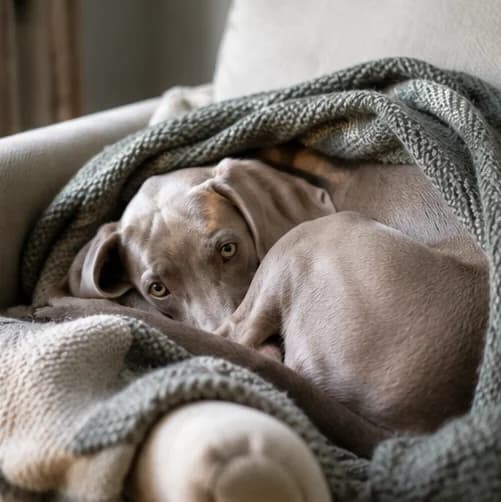
The easiest absence is one your puppy sleeps through. Choose moments when your puppy is already winding down: after a play and toilet break, after a meal, or when they have flopped onto their bed. A tired, comfortable puppy has nothing pulling them towards worry.
- Settle your puppy first. Play, toilet, then a quiet spell with a chew in their safe space.
- Step away without ceremony. Walk out of sight, no goodbye speech. Pop into the next room, put the kettle on, come back.
- Return before they fuss. Come back while your puppy is still relaxed. Keep the greeting calm; a quiet word is enough.
- Repeat through the day. Many tiny, boring separations teach more than one long one.
- Add a door. Once stepping out of sight is a non-event, close a baby gate or door for a moment, then open it again.
- Vary everything. Mix very short absences in with slightly longer ones, at different times of day, so leaving never follows a predictable pattern.
RSPCA UK describes the same approach: reward your dog for being relaxed, move further away and for longer only as they cope, and go back to the previous stage if they react.1 There is no fixed timetable. How quickly you progress depends entirely on your puppy.1
Food toys and a safe space
Give your puppy a place that feels good to be in: a bed, a pen or a crate they have learned to love, somewhere quiet but not shut away from family life. Make it the spot where good things happen.
A food toy or a long-lasting chew gives your puppy something to do as you leave. RSPCA UK suggests keeping a "special" toy just for times you go out, and reminds owners to take any treats from the puppy's daily food allowance.1 It also gives you information. RSPCA UK says a dog who leaves something they would normally enjoy may be worried.1 So if the food toy is untouched when you get back, read that as a sign to slow down, not a sign your puppy is full.
Things that help a puppy rest while you are away:
- a toilet break and some play beforehand
- the radio or closed curtains if outside noise sets them off2
- bedding that smells of home
- a safe set-up with nothing to chew that could hurt them (cables, shoes, houseplants)
Reading panic versus protest
Puppies can grumble when they do not get what they want, and that is different from panic. Learning to tell the two apart is a skill worth building early.
| Protest (usually fine) | Panic (stop and rethink) |
|---|---|
| A short whine or bark, then settling | Sustained crying, howling or barking that builds |
| Chews the food toy, then sleeps | Ignores food completely |
| Lies down, changes position, sighs | Pacing, panting, drooling or trembling |
| Plays with a toy or explores | Scratching or chewing at the door or gate |
| Normal greeting when you come back | Frantic greeting, or wet with drool |
Panic is the signal to make your next absence much shorter. Do not leave a panicking puppy to cry it out. RSPCA UK explains that dogs and puppies left to cry it out learn only that being alone is terrifying.2 AVSAB likewise recommends very gradual exposure that keeps a dog feeling safe, rather than exposing them to what frightens them until they give up.3
There is one exception to "come back while they are quiet": a puppy who might need the toilet. If in doubt, take them out calmly and try a shorter absence next time.
Building up gradually
Once your puppy can relax with you out of sight for a short time, you can start to practise real departures: picking up keys, putting on a coat, opening and closing the front door, going out briefly and coming back. Practise these cues on their own too, at random, so they stop predicting that you are about to leave.
Keep building in small, uneven steps. A good rule is that most sessions should feel easy. If your puppy copes well several times in a row, add a little. If they struggle, drop back. RSPCA UK suggests repeating each stage until you are sure your dog is happy before moving on.1
If you will have to leave your puppy for longer than they can cope with before you have built it up, arrange help rather than hoping for the best: family, a friend, a puppy sitter. RSPCA UK suggests the same.1
Cameras and checks
A cheap camera or an old phone on a video call is a very useful training tool. RSPCA UK recommends that owners video their dog when left alone from time to time, because hidden signs of distress such as trembling, pacing or whining are easy to miss.1 Research quoted by RSPCA UK suggests many dogs who find being alone hard show no obvious signs at all.2
Use the camera to:
- see exactly when your puppy settles, and when any worry starts
- check that the food toy is being eaten
- watch for the first signs of panic, so you can return or shorten the next session
- keep checking as your puppy grows, especially during adolescence and after changes at home
If it is not working
Some puppies find this harder than others, even with careful work. If your puppy panics even at very short absences, gets worse instead of better, or the camera shows distress you did not expect, move to the plan in our separation anxiety guide.
When to get help
Talk to your vet if your puppy shows distress when left, stops eating, or seems unwell; health problems can contribute to separation-related behaviour.2 Your vet can refer you to a qualified behaviourist, such as a veterinary behaviourist or a clinical animal behaviourist, who uses reward-based methods only. Under the Pet Professional Guild's principles, shock, prong and choke equipment, pain, fear and force are never used in training or management, and that is the standard to look for.5 Our editorial policy explains why.
Common questions
Should I let my puppy cry it out at night or when I go out?
No. RSPCA UK warns that crying it out teaches a puppy that being alone is terrifying. A short grumble that fades is fine; sustained crying means your puppy needs you, or a shorter absence next time.
My puppy follows me everywhere. Is that a problem?
Not on its own. Following you is normal for a people-loving breed. Practise short, calm absences so your puppy also learns that you always come back.
How long can I leave my puppy alone?
There is no single answer, and we do not give one. It depends on your puppy's age, toilet needs and how relaxed they are on camera. Build up gradually and ask your vet about toileting needs.
Footnotes
-
RSPCA UK, Training your dog to be left alone. ↩ ↩2 ↩3 ↩4 ↩5 ↩6 ↩7 ↩8
-
RSPCA UK, Recognising separation-related behaviour and anxiety in dogs. ↩ ↩2 ↩3 ↩4
-
AVSAB, Position statement on humane dog training (2021). ↩
-
RSPCA UK, Playpen and crate training a puppy. ↩
-
Pet Professional Guild, Guiding principles. ↩
Sources
Something wrong or out of date? Request a correction.