
Weimaraner recall training
Recall is hard for a hunting breed, so build it at home first, then on a long line, with rewards your Weim values more than the chase.
Recall is hard for a hunting breed because the world is full of things your Weimaraner was bred to find. The answer is not to be louder; it is to make coming back worth more than the chase. Build it at home, practise it on a long line, and only go off lead where it is safe and allowed. This guide is part of our training and behaviour hub.
Key takeaways
- Every time your Weim comes back, something good happens, even if they took their time
- Use a long line on a harness in open spaces until recall is reliable around real distractions
- Never call your dog to you for something unpleasant, and never punish a late return
Why is recall hard for a hunting breed?
The Weimaraner Club of America describes the Weim as a big, active, intelligent hunting breed with the stamina and drive to work for long stretches.1 That nose, speed and drive are why many Weims are wonderful companions on a run, and why a scent trail or a bolting rabbit can switch off their ears.
This is not your dog ignoring you out of disrespect. AVSAB's position statement on rank-based training explains that dogs fail to come when called when they are being rewarded by the things that are distracting them.2 A rabbit, a scent or another dog is a reward in itself. So the job is simple to describe and slow to do: teach your dog that coming to you always pays, and set up practice they can win.
Understanding the breed helps; our guide to Weimaraner temperament covers prey drive and arousal in more depth.
Foundations at home
Start where nothing much is happening: your kitchen, hallway or garden. RSPCA Australia suggests beginning with a "follow me" game at home in a low-distraction place,3 and Dogs Trust suggests teaching your dog to respond to their name before you add a recall cue.4
- Teach the name. Say your dog's name once; when they look at you, mark it ("yes") and reward. Do this often and in passing.
- Play follow me. Drop a treat on the floor and walk away a few steps. As your dog finishes it, say your recall cue once, mark the moment they turn towards you, and reward when they arrive.
- Pick one cue and stick to it. A short word like "come" or "here", or a whistle, plus a visual cue such as open arms in case they cannot hear you. Everyone in the house uses the same one.4
- Reward at your body. Deliver the treat close to you, and sometimes touch the collar or harness gently as you do, so being caught becomes part of the good stuff.
- Add small distractions. A toy on the floor, a family member walking past, then the garden.3
- Stop while it is easy. A few good recalls beat a long session that ends in failure.
The long line
A long line is a lightweight lead, much longer than a normal one, that lets your Weim sniff, run and explore while you keep a safety net. Dogs Trust recommends using a long line attached to a harness during training, and gently guiding your dog in if needed, never pulling them towards you.4 RSPCA Australia suggests practising on a long lead in public: let your dog sniff and run, call them back often, reward, and let them go again.3
Some practical habits:
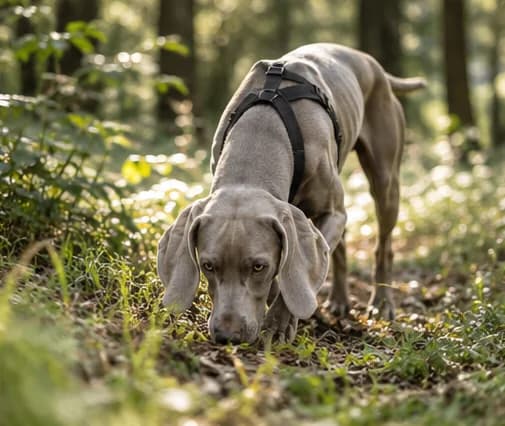
- clip the line to a well-fitting harness, not a collar, so a sudden stop does not jolt the neck
- let the line trail or hold it loosely; it is there for safety, not to reel your dog in
- wear gloves if the line could run through your hands
- take care around other people, bikes and dogs, so nobody gets tangled
- avoid retractable leads for this; they teach that pulling makes the lead longer
Reward value and games
In a quiet kitchen, a piece of kibble might be enough. Out in the field, you are competing with every smell in the field. RSPCA Australia advises using high-value rewards and saving a favourite toy just for training to keep its value.3 When your dog comes back against the odds, give them a jackpot: a much bigger reward to show that was the right choice.3
Find out what your Weim loves most. For many, it is real food (cooked chicken, cheese), a game of tug, or a thrown toy to chase. For some, the best reward is being allowed to go back to what they were doing.
Games that build recall:
- Run away. Call once and run away from your dog; most dogs chase. RSPCA Australia suggests this instead of ever chasing your dog, which can turn into a game that runs them into danger.3
- Ping-pong recall. Two people call the dog back and forth, rewarding each arrival.
- Hide and seek. Hide in the garden or house, call once, and celebrate when you are found.
- Recall then release. Call, reward, and send your dog straight back to sniffing. RSPCA Australia notes that some dogs avoid their owner when they know coming back means the end of the fun.3
Scent games are a good outlet for a Weim nose, and they help with recall too, because a dog whose nose has had work is easier to call away. See scent games for Weimaraners.
Proofing around distractions
Proofing means practising in harder and harder places, one small step at a time. Dogs Trust suggests gradually increasing the distance and the level of distractions you call your dog away from.4 RSPCA Australia suggests only calling when you think your dog will come during training, and waiting until you have their attention rather than calling into a scent or a chase.3
Plan your progress in small jumps:
- Garden with a toy lying around
- Quiet park, early morning, on a long line
- Same park with a few people in the distance
- Other dogs far away, then closer
- Birds, rabbits and scent trails, last of all
If you call twice and your dog does not respond, RSPCA Australia suggests going to collect them calmly and practising again somewhere easier.3 Repeating the cue over and over teaches your dog it is background noise. Meeting your dog's need to run and sniff in other ways helps too: a dog who is under-exercised will make the most of any chance off lead.3 Our guide on how much exercise a Weimaraner needs covers that side.
Emergency recall
Many force-free trainers teach a separate emergency recall: a distinct whistle pattern or word kept only for "come back right now". It works because it is never wasted and always paid well.
- choose a cue you would never say by accident
- pair it with your dog's very best reward, every single time, starting at home
- practise it rarely enough to stay special, but often enough to stay sharp
- never use it to end a game, go home, or do something your dog dislikes
An emergency recall is a safety net, not a licence. RSPCA Australia is clear that a perfectly reliable recall is unrealistic, because you cannot control what happens around you.3
Off-lead decisions and local rules
Before you unclip, ask yourself three things: is it allowed, is it safe, and is my dog ready?
- Allowed. Off-lead rules vary between councils, parks, beaches and countries. Check the signs and your local council's rules; we do not summarise the law here.
- Safe. RSPCA Australia advises never walking your dog off lead near a road or other dangerous areas, however reliable their recall.3 Keep your Weim on a lead near livestock, wildlife habitats and cliff edges.
- Ready. RSPCA Australia suggests your dog's recall should be at least 80% reliable on a long lead in highly distracting situations before you move to off-lead practice in a secure, low-distraction public area.3
Some Weims, especially those with strong prey drive, may never be safe off lead in open country. That is not a failure. A long line, a secure field you can hire, or scent games can give the same joy safely.
When to get help
Ask a qualified reward-based trainer for help if recall is not improving, or if your dog bolts and does not come back. Talk to your vet and a qualified behaviourist if your dog runs off in fear (for example at noises), shows aggression to other dogs or people, or seems anxious on walks: fear-related problems need a different plan. Your vet can also check whether a health problem is playing a part.5
When choosing help, look for someone who uses reward-based methods only. AVSAB recommends reward-based training for all dogs and says aversive methods should not be used,5 and under the Pet Professional Guild's principles, shock, prong and choke equipment are never used.6 Our editorial policy explains our approach. Next, work on the lead itself with loose-lead walking.
Common questions
Should my Weimaraner ever be off lead?
Some can be, in safe, permitted places, once recall is reliable on a long line around real distractions. Others are happier and safer on a long line for life. See off-lead decisions.
What if my Weim ignores me at the park?
Do not keep calling. Go and collect them calmly, then practise again somewhere easier with better rewards. Never tell them off when they do come back.
Is a whistle better than a word?
Either works. A whistle carries further and sounds the same whoever blows it. What matters most is that the cue always predicts something good.
Footnotes
-
Weimaraner Club of America, Living with a Weimaraner. ↩
-
AVSAB, position statement on rank-based theories in behaviour modification: avsab.org. ↩
-
RSPCA Australia, How can I teach my dog recall (to come when called)? ↩ ↩2 ↩3 ↩4 ↩5 ↩6 ↩7 ↩8 ↩9 ↩10 ↩11 ↩12 ↩13
-
Dogs Trust, How to train your dog to come back when called. ↩ ↩2 ↩3 ↩4
-
AVSAB, Position statement on humane dog training (2021). ↩ ↩2
-
Pet Professional Guild, Guiding principles. ↩
Sources
- RSPCA Australia: How can I teach my dog recall (to come when called)?
- Dogs Trust: How to train your dog to come back when called
- AVSAB: Position statement on humane dog training (2021)
- AVSAB: Position statement on the use of dominance theory in behavior modification of animals
- Pet Professional Guild: Guiding principles
- Weimaraner Club of America: Living with a Weimaraner
Something wrong or out of date? Request a correction.