
How much exercise does a Weimaraner need?
A lot, every day: breed authorities set a high daily figure for adult Weimaraners, and the mix of running, sniffing and training matters as much as the total.
Weimaraners were bred to work all day in the field, and most adults still have the engine for it. The honest answer is "a lot, every day", but the shape of that exercise matters more than chasing a number. This guide sits in our activities and enrichment hub and covers healthy adults; puppies have their own guide.
Key takeaways
- The Royal Kennel Club describes an adult Weim's need as more than two hours a day: treat that as a guide, not a target1
- Mix running with sniffing, training and games, because a tired body with a bored brain is still a restless dog
- Puppies, adolescents, seniors and hot days all change the plan: see the growing-puppy guide
The honest answer
There is no single figure that suits every Weimaraner, but the breed authorities agree the need is high. The Royal Kennel Club lists the breed's exercise need as "more than 2 hours per day".1 The PDSA, a UK veterinary charity, goes further and calls two hours "the minimum" for an adult Weimaraner, including long walks and safe off-lead running.2 The Weimaraner Club of America puts it in three words, "Weimaraners need exercise", and adds that they prefer exercise they can do with you.3
Those are statements about healthy adult dogs, and they describe a daily habit rather than a one-off weekend hike. Your own dog's age, fitness, health and temperament all shift the answer. A lean, fit field-bred dog may want more; a dog recovering from injury, carrying extra weight or living with a joint problem may need a different plan altogether, and that plan is one to make with your vet.
It also helps to know what the breed was built for. The American Kennel Club notes that Weimaraners were bred to hunt all day and then live indoors with their owners in the evening.4 That second half matters: a well-exercised Weim is usually a calm housemate, while an under-exercised one tends to find its own work, often with your furniture.
Quality over distance
The same pavement loop, day after day, will not satisfy most Weimaraners. They are hunting dogs with a strong nose, a quick brain and a strong attachment to their people, and good exercise feeds all three.
Think of a day's activity in four parts:
- Running and free movement. Safe, fenced or legally permitted off-lead areas, or a long line in open space, let a Weim stretch out at its own pace. Never let a dog off lead until recall is reliable: our recall guide explains how to build it.
- Sniffing. Letting your dog follow its nose is not wasted time. In one controlled study, pet dogs that did regular nosework became measurably more "optimistic" in a judgement-bias test, while dogs doing heelwork did not.5 Our scent games guide has ideas you can start today.
- Training and problem solving. Short sessions of reward-based training, food puzzles and new tricks tire the brain. RSPCA Australia lists puzzle toys, scent games and reward-based training among the enrichment that keeps dogs mentally well.6
- Rest. A dog that never switches off is not necessarily a dog that needs more running. Many busy Weims need help learning to settle, which our settling and calm guide covers.
The aim is a dog that comes home content, not one that is so wound up by repetitive ball-chasing that it cannot relax.
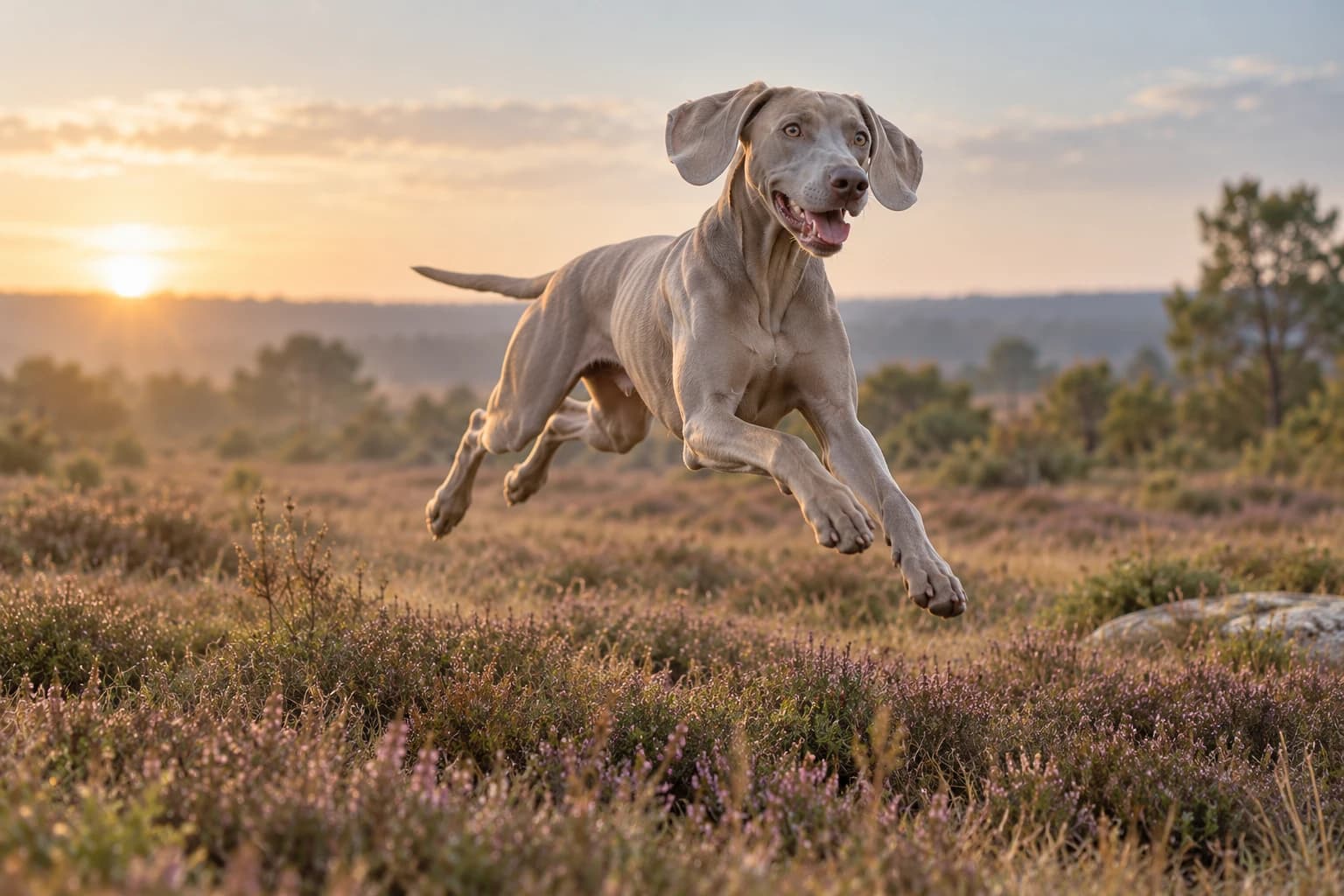
A weekly mix
Variety keeps exercise interesting for both of you and spreads the physical load across different muscles and joints. A realistic mix for a healthy adult might combine:
- A longer outing most days. A walk, hike or run with plenty of chances to sniff and explore, adjusted to the weather and your dog's fitness.
- A shorter "brain" session daily. Scent games, a training session or a food puzzle, often at the time of day your dog is most restless.
- Regular free running. Somewhere safe and legal, ideally with a friendly, well-matched dog or a game of fetch you can stop before your dog is overexcited.
- Something new now and then. A different trail, a beach, a swim in safe water or a class in a dog sport such as scent work or agility.
- Easy days. After a big day, a gentler one with sniffing and rest helps your dog recover.
If you run with your dog, build distance gradually, as you would for yourself, and ask your vet to check your dog is fully grown and fit before you start. Running is a natural fit for many adult Weims, but a pavement run in the heat is a very different load from a soft woodland trail on a cool morning.
Heat, cold and surfaces
Weimaraners have short coats and enthusiastic natures, which is a risky combination on a warm day: many will keep running long after they should stop. The RSPCA in the UK says dogs are far more likely to suffer heat-related illness from exercising in hot weather than from being left in cars.8 On hot days, shorten or skip the outing, choose shade and water, and swap running for a calm scent game indoors.
Surfaces matter too. RSPCA Australia notes that in sunny, dry spots even bare ground and brown grass can become hot enough to be unsafe for dogs, not just concrete or asphalt.7 Check the ground with the back of your hand, and remember sand and pavement hold heat.
Cold weather brings its own questions, from whether a short-coated dog needs a coat to how to handle icy ground. Those are worth asking your vet, who knows your dog's age and condition.
Adolescents
Adolescence is often when owners feel their Weim's energy has doubled, and when recall and lead manners seem to evaporate. This is a normal stage, not a sign that you need to run the dog into the ground. An adolescent may still be growing, so ask your vet whether your dog is ready for longer runs, repeated jumping or hard surfaces before building them in.
What usually helps more than extra mileage:
- more sniffing and exploring on a long line,
- short, frequent training sessions that keep recall rewarding,
- predictable rest, because overtired adolescents are often the most frantic,
- and plenty of calm time with you at home.
If your adolescent seems unable to settle at all, or if you see distress when they are left, talk to your vet and a qualified behaviourist rather than adding more exercise.
Seniors
Many Weimaraners stay active into old age, but the mix changes and the right amount is a question for your vet, who can check for pain or stiffness and suggest how to adapt. Stiffness after exercise, slowing on the way home, reluctance to jump into the car or a change in breathing are all reasons to book that visit.
Keep the brain busy as the body slows. Scent games, gentle training and food puzzles let an older Weim keep doing the things it loves without the impact of running.
Puppies: see the growing-puppy guide
This guide is about adult dogs. Puppies and young dogs are still growing, and how much and what kind of exercise suits them is a question for your vet. Our exercise for growing puppies guide explains the principles and the questions to ask, without fixed amounts.
When to get help
See your vet if your dog's appetite for exercise changes suddenly, if they limp, tire unusually quickly, struggle to breathe, or seem stiff or sore afterwards. If your dog is restless, destructive or distressed despite plenty of exercise, a vet check and a qualified behaviourist can help find the cause.
Common questions
Is the breed-club figure really enough, or too much?
Can I tire my Weimaraner out with fetch?
Fetch is fun, but endless repetitive chasing can leave some dogs more wound up. Mix it with sniffing, training and calm breaks: see quality over distance.
What if I cannot give my dog that much time?
Be honest with yourself before you get a Weimaraner. If circumstances change, a reputable dog walker, day care that suits your dog, or more brain work at home can help, and our breed-fit quiz is a useful reality check before you commit.
Footnotes
-
Weimaraner Club of America: Living with a Weimaraner. ↩
-
American Kennel Club: Weimaraner facts you may not know. ↩
-
Duranton C, Horowitz A (2019). Let me sniff! Nosework induces positive judgment bias in pet dogs. ↩
-
RSPCA Australia: The importance of enrichment for dogs. ↩
-
RSPCA Australia: How can I protect my dog from heatstroke? ↩ ↩2 ↩3
-
RSPCA (UK): Dogs die on hot walks. ↩
Sources
- Royal Kennel Club: Weimaraner breed information
- PDSA: Weimaraner
- Weimaraner Club of America: Living with a Weimaraner (Carole Lee Richards)
- American Kennel Club: Weimaraner facts you may not know
- RSPCA Australia: How can I protect my dog from heatstroke?
- RSPCA (UK): Dogs die on hot walks
- RSPCA Australia: The importance of enrichment for dogs
- Duranton C, Horowitz A. Let me sniff! Nosework induces positive judgment bias in pet dogs. Applied Animal Behaviour Science, 2019
Something wrong or out of date? Request a correction.