
Scent games for Weimaraners
Scent games give a Weimaraner's hunting nose real work: start with find-it at home, add scatter feeding and trails, and you may discover a new sport together.
A Weimaraner's nose is the reason the breed exists. Scent games turn that nose into a daily outlet: they tire the brain, build confidence and give you something to do together on a wet afternoon. You need almost no equipment, and every game below uses rewards, never pressure. This guide is part of our activities and enrichment hub.
Key takeaways
- Sniffing is real exercise for a Weim's brain, and research links regular nosework with a more positive outlook in dogs
- Start easy, at home, with food your dog loves; make it harder only as your dog succeeds
- Scent work can grow into a sport, and it fits well alongside settling and calm and recall training
Why a gundog nose needs work
Weimaraners were bred to find game. The American Kennel Club credits the breed's working history with "exceptional tracking ability", and notes that owners joke it is "cheating" to enter tracking events with a Weimaraner because they are such naturals.1 A dog with that kind of nose and nothing to use it on often goes looking for its own work: bins, counters and the neighbour's chickens.
Sniffing does more than keep a dog busy. In a study of pet dogs, those that did regular nosework became more "optimistic" in a cognitive bias test, approaching an ambiguous signal faster, while dogs that practised heelwork did not change.2 The authors suggest that giving dogs more time to use their sense of smell improves their welfare.2 RSPCA Australia also lists scent games, such as snuffle mats, among the mental enrichment that keeps dogs well, alongside puzzle toys and reward-based training.3
Scent work is also low impact. It suits a young dog that is not ready for long runs, an older dog slowing down, and any Weim on a hot day when outdoor exercise is unsafe. For how scent games fit into a balanced exercise routine, see how much exercise a Weimaraner needs.
Find-it at home
"Find it" is the foundation game. It teaches your dog that using its nose earns rewards, and it works in a kitchen, a hallway or a hotel room.
- Choose a reward your dog loves. Small pieces of your dog's own food work for many Weims; use something tastier if your dog is less food-motivated.
- Start in plain sight. With your dog watching, say "find it" and drop a piece of food on the floor a short distance away. Praise as your dog eats it.
- Make it slightly harder. Place the food behind a chair leg or just around a doorway while your dog watches, then say "find it".
- Hide it while your dog waits. Ask a helper to hold your dog, or use a settle on a mat your dog already knows, then hide the food in an easy spot and release your dog with "find it".
- Add more hides gradually. Several easy hides in one room, then a second room. Keep sessions short and stop while your dog is still keen.
If your dog gets stuck, make the next hide easier rather than pointing it out. The aim is a dog that searches with confidence, not one that waits for you to help.
Scatter feeding and snuffle mats
Scatter feeding is the simplest scent game of all: instead of serving a meal in a bowl, scatter part of it across clean grass or a snuffle mat and let your dog forage. A snuffle mat is a fabric mat with long strips that hide pieces of food; a rolled towel or a cardboard box filled with scrunched paper works on a budget.
A few tips:
- Use part of your dog's daily food rather than extra treats, so enrichment does not lead to weight gain. RSPCA Australia notes that over-reliance on feeding enrichment can increase the risk of obesity.3
- Supervise, especially at first. Some dogs chew or swallow the mat or the box, and RSPCA Australia warns that toys used for enrichment can be a hazard if swallowed.3
- Rotate games. RSPCA Australia points out that the same toys day in and day out stop being enriching because dogs get bored.3
Tracking a trail
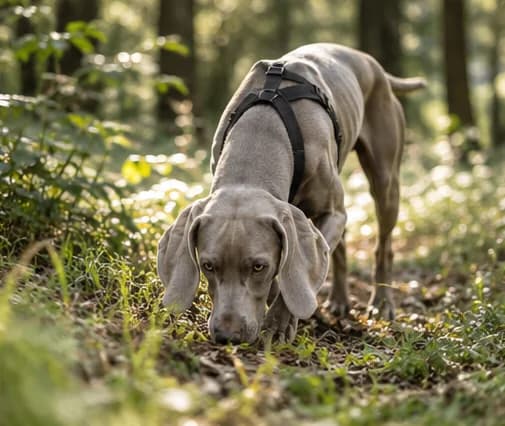
Tracking asks your dog to follow the scent path a person or object has left on the ground. It is close to the work the breed was developed for, and many Weims take to it quickly.
- Start on short grass on a calm day. Ask a helper to hold your dog on a harness and long line while you walk a short, straight line away, dropping a small treat at every step or two.
- Leave a jackpot at the end. Put a favourite toy or a handful of food at the end of the trail, then walk back the way you came.
- Let your dog follow at its own pace. Hold the long line loosely and let your dog work out the trail with its nose. Celebrate at the end.
- Spread the treats out over time. As your dog follows the line confidently, drop food less often, then add gentle turns and longer trails.
Use a well-fitted harness rather than a collar for tracking, so your dog can pull into the scent without pressure on its neck. The Pet Professional Guild's principles are a good test for any equipment or method: never use anything that relies on shock, pain, fear or force.4
Scent work as a sport
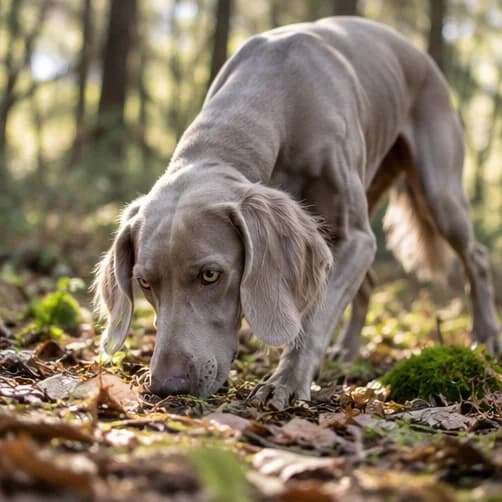
If your Weim loves searching, scent work is an organised sport built on it. Dogs Australia's rules describe scent work as a sport based on the task of working detection dogs, where a dog locates a target odour and communicates the find to its handler.5 In AKC Scent Work, dogs search for cotton swabs scented with essential oils, and both purebred and mixed-breed dogs can take part.6 The AKC describes it as a wonderful way to build confidence in a shy dog.6
Rules, age limits and registration requirements differ by country and organisation, so check with your national kennel club or a local scent-work club before you enter a trial. A class with a reward-based instructor is the easiest way to start, and it will teach you to read the small changes in your dog's body language when it finds odour.
Scent work also helps everyday training. A dog used to working calmly with its nose is often easier to settle, and searching games can be a useful reward when you are building recall.
Safety: foods, heat and hazards
- Heat. Searching is hard work for a dog. In warm weather, play indoors or in the shade, keep sessions short and have water ready. RSPCA Australia lists exercise in hot weather among the risk factors for heatstroke.8
- Weight. Count food used in games as part of your dog's daily ration.
- Frustration. If your dog starts digging frantically, barking or chewing the hiding places, make the game easier and end on a success. Some dogs find searching exciting at first; calm, simple games help.
- Health. If your dog's interest in sniffing or food suddenly changes, or it seems unwell, check with your vet.
Common questions
My Weimaraner isn't food-motivated. Can we still play?
Yes. Hide a favourite toy instead, and reward the find with a game of tug or fetch. Keep it easy until your dog understands the game.
Will scent games make my dog sniff more on walks?
They usually make sniffing more purposeful, not less manageable. Pair them with loose-lead and recall training, and build in "sniff breaks" on walks so your dog knows when it is free to explore.
Is my Weim too young or too old for scent work?
Most dogs can enjoy simple search games at any age, because they are low impact. For a young puppy or an older dog with health problems, keep sessions short, and ask your vet if you are unsure.
Footnotes
-
American Kennel Club: Weimaraner facts you may not know. ↩
-
Duranton C, Horowitz A (2019). Let me sniff! Nosework induces positive judgment bias in pet dogs. ↩ ↩2
-
RSPCA Australia: The importance of enrichment for dogs. ↩ ↩2 ↩3 ↩4
-
Pet Professional Guild: The Guiding Principles. ↩
-
Dogs Australia: Rules for the conduct of Scent Work trials. ↩
-
RSPCA Australia: What should I feed my dog? ↩
-
RSPCA Australia: How can I protect my dog from heatstroke? ↩
Sources
- Duranton C, Horowitz A. Let me sniff! Nosework induces positive judgment bias in pet dogs. Applied Animal Behaviour Science, 2019
- RSPCA Australia: The importance of enrichment for dogs
- American Kennel Club: Weimaraner facts you may not know
- American Kennel Club: AKC Scent Work
- Dogs Australia: Rules for the conduct of Scent Work trials (effective August 2024)
- Pet Professional Guild: The Guiding Principles
- RSPCA Australia: What should I feed my dog?
- RSPCA Australia: How can I protect my dog from heatstroke?
Something wrong or out of date? Request a correction.